
Blog
The Inspiring History and Meaning of the Italian Flag
Discover the story behind the Italian flag—its origin, symbolism, colors and how it reflects Italy’s journey. A reader-friendly guide to the tricolour.

Introduction
Imagine a vivid banner of green, white and red fluttering in the breeze, capturing not only attention but also telling the story of a nation. That is the essence of the Italian flag, a seemingly simple tricolour that carries centuries of history, culture and identity. From its earliest appearances during revolutionary times to its place on the modern world stage, the Italian flag stands as a visual emblem of unity, pride and transformation.
In this article, we dive deep into the Italian flag: exploring its origins, meaning, design, how it is used today, and why it matters more than ever. We’ll also address lesser-known facts, the symbolism of its colours, and how the flag has shaped Italy’s national identity. Whether you’re a student, traveller, or just curious, this guide will give you a clear and engaging look at the Italian flag.
What the Italian Flag Looks Like
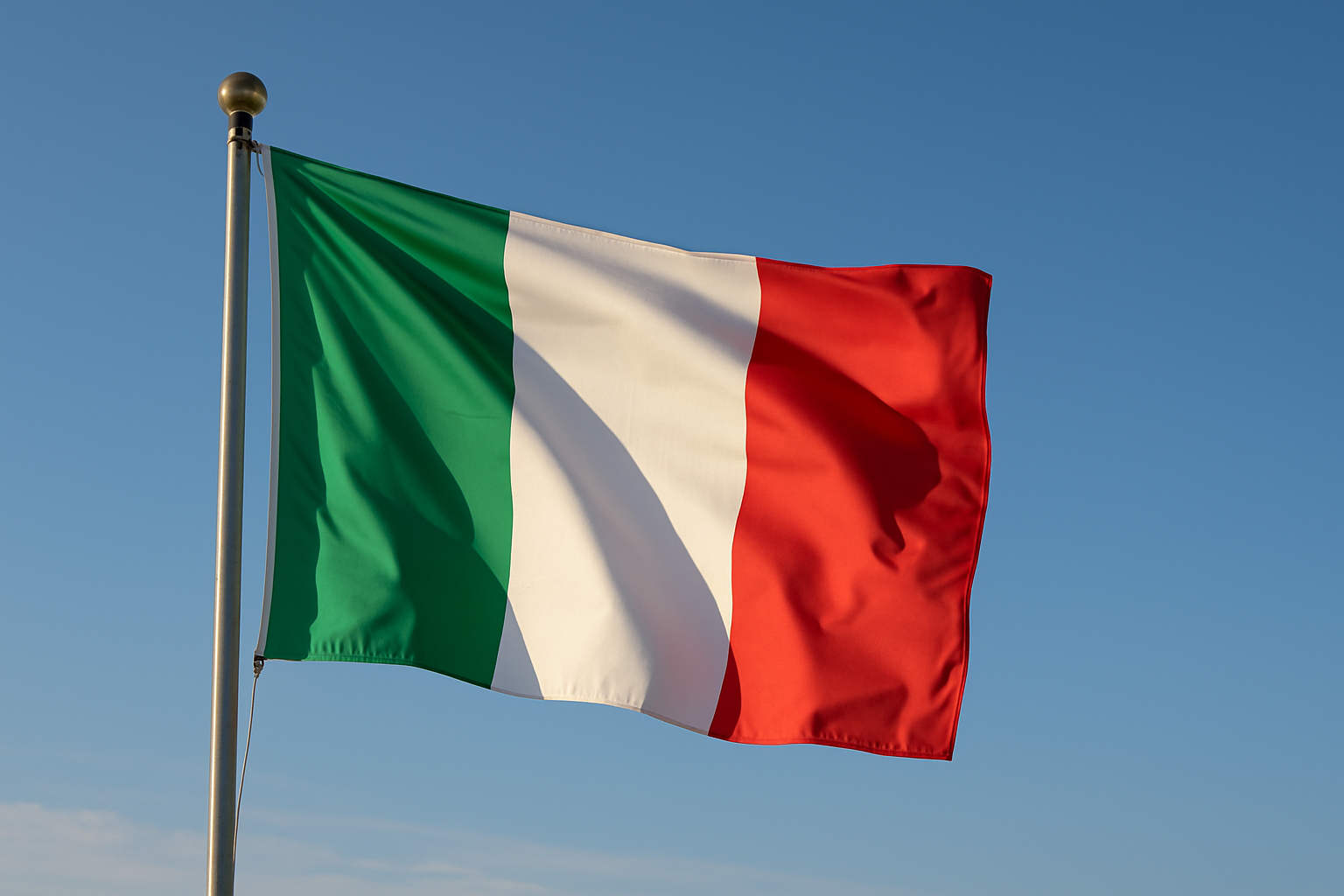
The Italian flag features three vertical bands of colours: green on the hoist side (left when flying), white in the centre, and red at the fly side. The official proportion is 2 : 3 (height to width).
If displayed horizontally, the arrangement remains green-white-red from left to right. According to Italian law, the flag must be treated with respect, displayed in its correct orientation, and maintained in good condition.
The design is clean yet striking: the strong primary colours set side by side create a bold and memorable visual. There are no additional emblems or designs in the standard civil version, making the Italian flag one of the more recognisable national flags in the world.
Origins and Historical Evolution of the Italian Flag
Early beginnings and inspiration
The Italian flag traces its roots to the late 18th century, influenced by the ideals of the French Revolution and the Napoleonic campaigns in Italy. On 7 January 1797 the Cispadane Republic adopted a tricolour of green, white and red as its banner.
This early version marked the start of a symbol that would become linked to Italian nationalism and the drive toward unification.
The Risorgimento and national unification
During the mid-19th century, the Italian flag was a symbol of the Risorgimento—the movement that unified the various Italian states into the Kingdom of Italy. For example, in 1861 when the Kingdom of Italy was proclaimed, the tricolour gained official status.
Over time, as Italy transitioned through monarchy, fascism, war and then republic, the Italian flag remained, though variants and additional symbols appeared in military or royal contexts.
Establishment under the modern republic
After World War II and the referendum of 1946 that ended the monarchy, the Italian flag in its modern form (without royal coats of arms) was affirmed under the republic. Italian law (Article 12 of the Constitution of 1947) states: “The flag of the Republic is the Italian tricolour: green, white and red, in three vertical bands of equal size.”
Symbolism and Meaning Behind the Italian Flag
Colour interpretations
The colours of the Italian flag carry multiple layers of meaning—both historical and symbolic. One widely cited interpretation is that the green represents the country’s plains and hills, the white the snow-capped Alps, and the red the blood shed for independence and freedom.
Another traditional interpretation assigns virtues: green for hope, white for faith, and red for charity or love.
Because the Italian flag’s origins rest on revolution, unity and transformation, these colour meanings deepen its significance beyond mere decoration.
National identity and unity
Beyond the colours, the Italian flag stands as a beacon of national identity. It symbolises the coming together of different regions, dialects, traditions and histories into one unified Italy.
In public ceremonial uses, at schools, government buildings, and during national holidays, the Italian flag is displayed proudly—serving as a visual reminder of civic unity, shared values and collective heritage.
Cultural and historical weight
During struggles such as the wars of independence and finally the establishment of the republic, the Italian flag was raised, carried by volunteers, and used in propaganda and public expression. Thus the flag is not just a design but a symbol embedded in the narrative of Italian freedom, democracy and national resurgence.
How the Italian Flag Is Used Today
Official and public display
The Italian flag must be flown at official buildings, public institutions, schools and on certain national anniversaries. The flag must always be displayed respectfully—fully extended, in good condition, and never used as a mere drapery or for decoration in violation of protocol.
On national holidays such as Republic Day (2 June) and Liberation Day (25 April) the Italian flag is central in ceremonies and public gatherings.
Within education and citizenship
In Italy, children learn about the Italian flag as part of their curriculum on national symbols. The flag plays a role in civic education—its history, meaning and proper usage are taught so that citizens understand its importance.
Displaying the flag is also a mark of national pride: at sporting events, festivals, cultural occasions and even in the diaspora communities abroad.
Use abroad and in the diaspora
Italian communities worldwide often display the Italian flag to mark Italian heritage, cultural festivals or local celebrations like the Festa della Repubblica. The tricolour becomes a link between generations, countries and cultural memory.
Design, Protocol and Respect for the Italian Flag
Design specifications
As mentioned earlier, the official proportion of the Italian flag is 2 : 3 (height to width). The stripes must be equal width, with green at the hoist, white in the centre, and red at the fly. If displayed vertically, green must be on the left (hoist side) nearest the staff.
Colour shades are regulated in law (for example a ministerial decree about precise colour values was issued following a 2002 incident where shades were mistaken).
Protocol and respectful use
The Italian flag must never be used as simple decoration (for example as tablecloth or curtain) or allowed to fall into disrepair. Wikipedia In public mourning the flag may be raised at half-mast, and for certain ceremonies black ribbons may be attached (when used in funerary processions).
Proper storage, maintenance and respectful display are essential. The flag is also protected by law: insulting or defacing the Italian flag can be subject to legal consequences.
Fascinating Facts about the Italian Flag
The tricolour’s name and its first usage
The Italian flag is often referred to as il Tricolore. Its first formal adoption, as we noted, was in the late 18th century by the Cispadane Republic in 1797.
The French tricolour served as inspiration, yet the Italian version developed its own historic path.
Evolution through the monarchy, wars and republic
Under the Kingdom of Italy (1861–1946), the Italian flag often carried the House of Savoy’s coat of arms. With the republic established in 1946, the coat of arms was removed and the standard basic tricolour became the national emblem.
In regions, military units, and international contexts (such as the navy), variants of the Italian flag with emblems or different proportions appeared.
Similar flags and visual confusions
The Italian flag is very similar at a glance to the flag of Mexico (also green-white-red vertical stripes) but the Italian version is lighter in its shade of green and red, and lacks Mexico’s coat of arms in the centre; proportions differ as well.
Because of similarities, correct orientation and colour accuracy matter in distinguishing the Italian flag from other national flags.
Collecting and historic flags
For historians and collectors, earlier versions of the Italian flag, military issue variants, and flags from the Risorgimento era are prized. They serve as artefacts of Italian political and cultural history.
Why the Italian Flag Matters for Italy and Beyond
Symbol of unity and identity
In a country of diverse regions, dialects and traditions, the Italian flag helps consolidate a shared identity. The tricolour unites north and south, urban and rural, historical and modern Italy under one visual symbol.
At national events, celebrations and global sports, the Italian flag is raised to convey “we are one nation” and to stand for Italian culture, heritage and values.
Soft power and international recognition
When the Italian flag waves on the global stage—whether at world cups, diplomatic events or cultural festivals—it becomes a vessel of Italy’s soft power. It signals not just a country, but its cuisine, design, arts, tourism and global networks.
The clarity and recognisability of the Italian flag simplify its role as a brand of sorts: even without words, it evokes Italy’s reputation for beauty, craftsmanship and heritage.
Education, memory and civic expression
Through display at schools, ceremonies and public institutions, the Italian flag fosters civic awareness. It reminds citizens—young and old—of the nation’s past, the price of freedom and the responsibility to uphold shared values.
Memory plays a part: flags from historic battles, independence movements and civic uprisings still circulate in museums and public spaces. The Italian flag serves as the visual thread linking those past events to present national life.
How to Respect and Display the Italian Flag Correctly
Guidelines for correct display
- Always hoist the green stripe at the hoist side and ensure the white and red follow correctly.
- Keep the flag fully extended and avoid letting it drag on the ground or touch water or land.
- If displayed vertically, ensure the green stripe remains nearest the staff.
- Replace the flag if it becomes faded, torn or weather-worn; a well-kept flag reflects respect for what it stands for.
Contexts and positioning
When displayed alongside other flags (for example, the European Union flag), the Italian flag should have precedence as the national flag in Italian venues.
During national holidays, the flag should be flown prominently—on 2 June (Festa della Repubblica) and 25 April (Liberation Day) in particular.
In public ceremonies, ensure lighting is sufficient so the Italian flag is visible and colours remain true even at dusk or evening.
Avoiding common mistakes
- Don’t use the Italian flag as a mere decorative fabric (for example as a tablecloth or costume).
- Make sure the colours are correct: faded or off-hue flags may inadvertently disrespect protocol.
- Ensure the flag is appropriate for the setting: indoors on a staff, outside on a hoist—and if used at half-mast, observe respectful guidelines.
Celebrations, Events and the Italian Flag in Culture
National holidays and ceremonies
The Italian flag is central to major national holidays:
- 2 June: Festa della Repubblica (Republic Day), commemorating the 1946 referendum when Italy became a republic.
- 25 April: Liberation Day, marking the end of Nazi-Fascist occupation during WWII.
On these occasions the Italian flag flies everywhere—from public buildings to private homes—and ceremonies often involve raising the flag, military parades, and civic celebrations.
Sport, festivals and popular culture
In international sports such as football (soccer), the Italian flag is draped by fans, athletes and officials, often serving as a rallying point of national pride.
Cultural festivals, historical reenactments, and local events (for example regional fiestas) also feature the Italian flag as a unifying visual element across generations and venues.
Artistic and design interpretations
The Italian flag has appeared in art, design, fashion, and architecture: from paintings of the Risorgimento to modern graphic arts. Its three colours, simple layout and historic resonance make it a powerful design motif.
In fashion and branding, the green-white-red palette signals “Italian style” and is used globally to evoke an Italian connection—even in contexts far removed from politics.
Frequently Asked Questions (FAQ)
Q1: What do the colours of the Italian flag actually mean?
A: While there is no single official meaning, common interpretations include: green for the countryside or hope, white for faith or the snowy Alps, and red for charity or the blood of those who fought for independence.
Q2: When was the Italian flag first adopted?
A: The tricolour first appeared in 1797 under the Cispadane Republic. It became associated with national unification and was formally adopted by the Kingdom of Italy in 1861.
Q3: Is the Italian flag just three colours?
A: The standard civil version is three vertical bands of green-white-red. There are other official variants (for military, state, naval uses) that include emblems or different proportions.
Q4: How should the Italian flag be displayed indoors and outdoors?
A: Indoors, fly it on a staff with the green stripe nearest the staff. Outdoors, hoist it at full-mast in good condition. Avoid letting it touch the ground, water, or be used as mere decoration.
Q5: Can the Italian flag be used in fashion or branding?
A: While its colours and pattern often appear in Italian-inspired branding or design, the actual national flag must be displayed with respect and according to protocol. Using the essence of the palette is common, but care must be taken when using the official flag itself.
Q6: Why is the Italian flag important beyond Italy?
A: The Italian flag serves as a symbol of Italy’s culture, heritage, innovation and global presence. In diaspora communities and international contexts, it fosters recognition, connection and an emotional link to Italy’s identity.
Conclusion
The Italian flag is far more than a piece of fabric—it is a visual testament to Italy’s journey, its aspirations and its unity. From its green, white and red stripes to its role in flagging national identity and culture, the tricolour carries weight, meaning and presence. Whether you encounter the Italian flag at a parade, a school, a football stadium, or on a travel adventure, you are witnessing a symbol that resonates with history, pride and belonging.

The word lucipara evokes mystery, beauty, and the remarkable richness of life beneath the ocean’s surface. While not as widely recognized as famous coral destinations, Lucipara refers to a remote group of islands and surrounding waters in eastern Indonesia that are celebrated for pristine reefs, rare species, and untouched natural scenery. For divers, marine biologists, and nature lovers, lucipara represents one of the last truly wild underwater frontiers. Its ecological importance, geographic isolation, and breathtaking marine landscapes make it a fascinating subject for anyone interested in the wonders of the sea.
The Geographic Location and Significance of Lucipara
Lucipara is a small and isolated island group located in the Banda Sea, part of Indonesia’s vast and biologically rich archipelago. Situated far from major population centers, these islands are surrounded by deep, nutrient-rich waters that support a thriving marine ecosystem. Their remoteness has protected them from many of the threats that affect more accessible coastal areas, such as overfishing, pollution, and large-scale tourism development.
The Lucipara Islands are part of the broader Coral Triangle, a region recognized as the global epicenter of marine biodiversity. This area spans Indonesia, Malaysia, the Philippines, Papua New Guinea, Timor-Leste, and the Solomon Islands. Scientists consider it the most diverse marine environment on Earth, containing more coral species and reef fish than any other oceanic region. Within this extraordinary zone, lucipara stands out as a particularly pristine and underexplored marine sanctuary.
The geography of Lucipara is dramatic. The islands are low-lying and surrounded by steep drop-offs, submerged pinnacles, and expansive coral gardens. Strong currents sweep through the region, bringing nutrients that fuel the growth of corals and attract large pelagic species. This combination of isolation and oceanographic conditions creates ideal habitat for a wide range of marine organisms.
For researchers and conservationists, lucipara is invaluable. It serves as a living laboratory where scientists can study reef ecosystems in a relatively undisturbed state. By understanding how these ecosystems function naturally, experts can better assess the impacts of human activity on more developed marine regions around the world.
Will You Check This Article: Flugelhorn: The Warmest Voice in the Brass Family
Lucipara Marine Biodiversity and Ecosystem Richness
One of the most compelling aspects of lucipara is the extraordinary diversity of life found in its waters. Coral reefs here support thousands of species, from microscopic plankton to large apex predators. Hard corals form intricate structures that provide shelter, feeding grounds, and breeding sites for countless organisms.
Reef fish are abundant and colorful. Schools of anthias, butterflyfish, angelfish, and fusiliers create a constantly moving mosaic over the reef. Larger species such as groupers, snappers, barracudas, and trevallies patrol the outer edges. The healthy fish populations indicate a balanced ecosystem where predator-prey relationships remain intact.
Lucipara is also known for encounters with pelagic animals. Divers may observe sharks, manta rays, tuna, and occasionally dolphins or whales passing through the surrounding waters. These species are attracted by the strong currents and abundant food sources. Their presence reflects the high productivity of the marine environment.
Macro life is equally impressive. Nudibranchs, pygmy seahorses, crustaceans, and other tiny creatures inhabit coral branches and reef crevices. For underwater photographers, lucipara offers endless opportunities to capture both large and small marine subjects in excellent visibility.
The interconnected ecosystem extends beyond coral reefs. Seagrass beds and sandy bottoms provide habitat for juvenile fish, while open-water zones support migratory species. This ecological complexity makes Lucipara an important reservoir of biodiversity within the Coral Triangle.
Why Lucipara Is a Dream Destination for Divers
For experienced divers, lucipara is often described as a bucket-list destination. Its remote setting and limited accessibility create an atmosphere of adventure, while the underwater conditions offer some of the most spectacular diving in Southeast Asia. Clear water, healthy coral formations, and frequent sightings of large marine life contribute to an unforgettable experience.
Visibility in the area is often excellent, allowing divers to appreciate vast reef structures and dramatic underwater topography. Sheer walls descend into deep blue water, covered with soft corals, sea fans, and sponges. Schools of fish move through the currents, creating dynamic and immersive scenes.
Drift diving is a common feature of Lucipara expeditions. Strong currents carry divers along reef slopes and over submerged pinnacles. These currents also bring nutrients that support abundant marine life. While conditions can be challenging, they reward divers with thrilling encounters and pristine habitats.
Because Lucipara is usually accessed by liveaboard vessels, dive trips often include neighboring sites in the Banda Sea. This allows visitors to experience a wide variety of ecosystems during a single journey. The sense of remoteness, combined with world-class underwater scenery, makes lucipara one of the most sought-after destinations for serious diving enthusiasts.
Underwater photographers are especially drawn to the area. The combination of crystal-clear water, colorful reefs, and rare marine species provides ideal conditions for both wide-angle and macro photography. Every dive offers the possibility of discovering something extraordinary.
The History and Exploration of Lucipara
The Lucipara Islands have long been known to navigators crossing the Banda Sea, but they remained relatively obscure due to their isolated location. Historically, these islands served as reference points for sailors traveling between Indonesia’s eastern islands. Their reefs, however, were considered hazardous to ships unfamiliar with local waters.
Modern scientific and recreational interest in lucipara increased as marine exploration expanded throughout Indonesia. Divers and researchers began documenting the region’s exceptional reef health and biodiversity. Reports of pristine coral walls and abundant sharks helped establish Lucipara’s reputation as a hidden underwater treasure.
Marine expeditions have contributed significantly to our understanding of the ecosystem. Surveys have cataloged coral species, fish populations, and oceanographic conditions. These studies highlight the importance of protecting such remote habitats before they face increasing human pressure.
The exploration of Lucipara also reflects a broader trend in ecotourism. As well-known dive destinations become crowded, adventurous travelers seek lesser-known regions that offer authentic experiences and healthier ecosystems. Lucipara embodies this spirit of discovery and respect for nature.
Despite growing recognition among dive communities, the islands remain relatively untouched. Their continued isolation offers hope that future generations will still be able to witness the reefs in their natural state.
Conservation Challenges Facing Lucipara
Although lucipara remains remarkably pristine, it is not immune to environmental threats. Climate change, illegal fishing, and marine pollution pose risks even to remote ecosystems. Rising sea temperatures can cause coral bleaching, weakening reefs and reducing biodiversity.
Ocean acidification is another concern. As atmospheric carbon dioxide levels increase, seawater chemistry changes, making it more difficult for corals and shell-forming organisms to build their skeletons. Over time, this can compromise reef structure and resilience.
Illegal and destructive fishing methods, such as blast fishing or cyanide use, can devastate coral habitats. While remoteness offers some protection, effective monitoring and enforcement are essential to prevent exploitation. Unsustainable fishing also threatens populations of sharks and other top predators.
Marine debris, especially plastic waste, can reach isolated islands via ocean currents. Entanglement and ingestion affect turtles, seabirds, and fish. Even areas with minimal local human activity are vulnerable to pollution originating thousands of kilometers away.
Conservation efforts depend on collaboration between governments, scientists, local communities, and responsible tourism operators. By promoting sustainable practices and expanding marine protected areas, stakeholders can help ensure that lucipara remains a thriving ecosystem.
Lucipara and the Role of Sustainable Tourism
Sustainable tourism plays a critical role in protecting lucipara while allowing people to appreciate its natural beauty. Because the region is primarily visited by liveaboard divers, operators have an opportunity to minimize environmental impact and educate guests about conservation.
Responsible dive tourism emphasizes reef-safe behavior. Divers are encouraged to maintain buoyancy control, avoid touching corals, and respect marine wildlife. Briefings often include information about local ecology and the importance of preserving fragile habitats.
Liveaboard vessels can adopt eco-friendly practices such as reducing single-use plastics, managing waste properly, and using mooring buoys instead of anchors. These measures help prevent direct damage to reefs and reduce pollution.
Tourism also generates economic incentives for conservation. When healthy reefs attract international visitors, governments and local stakeholders gain a strong reason to protect marine resources. Revenue from ecotourism can support scientific research, monitoring programs, and protected area management.
Lucipara demonstrates how carefully managed tourism can create awareness and foster stewardship. Visitors often return home with a deeper appreciation for marine ecosystems and a stronger commitment to ocean conservation.
Scientific Importance of Lucipara for Marine Research
For marine scientists, lucipara offers a rare opportunity to study coral reef ecosystems with relatively low human disturbance. Such environments provide critical baseline data for understanding natural ecological processes and measuring the effects of environmental change.
Researchers use Lucipara to examine coral health, fish community dynamics, and species interactions. Comparisons with degraded reefs help identify factors that promote resilience. These insights can inform restoration efforts in damaged marine areas.
The region is also valuable for studying pelagic species and migration patterns. Satellite tagging and underwater surveys reveal how sharks, manta rays, and other large animals use remote habitats for feeding and movement across the Banda Sea.
Genetic studies may uncover previously undocumented species or unique populations. Because the Coral Triangle contains immense biodiversity, many organisms remain poorly understood. Lucipara’s isolation increases the possibility of scientific discoveries.
Long-term monitoring is particularly important as climate change accelerates. By tracking coral bleaching, species shifts, and oceanographic conditions, scientists can assess how resilient pristine ecosystems are under global stress. In this way, lucipara contributes to broader efforts to protect the world’s oceans.
Conclusion
Lucipara is far more than a remote cluster of islands in eastern Indonesia. It is a symbol of what the ocean can look like when nature is allowed to flourish with minimal human disturbance. From vibrant coral reefs and abundant fish life to scientific discoveries and sustainable tourism opportunities, lucipara represents one of the planet’s most extraordinary marine environments.
Its significance extends beyond the diving world. Lucipara offers researchers a vital reference point for understanding healthy reef ecosystems, while conservationists view it as a priority for long-term protection. As global pressures on the oceans continue to intensify, places like lucipara remind us of the importance of preserving biodiversity before it is lost. By supporting responsible tourism, scientific research, and marine conservation, we can help ensure that this hidden jewel of the Banda Sea remains a thriving sanctuary for generations to come.
Read More: Cryptoboostly.co.uk

The flugelhorn is one of the most expressive and soulful brass instruments ever created. With its mellow tone, rounded tubing, and lyrical character, it bridges the brilliance of the trumpet and the softness of the French horn. Whether heard in jazz ballads, brass bands, or orchestral settings, the flugelhorn offers a warm, velvety sound that instantly captures attention. Its unique voice has made it a favorite among soloists and arrangers alike. For musicians and listeners who appreciate rich tone and emotional depth, the flugelhorn is an instrument worth exploring.
The Origins and Evolution of the Flugelhorn
The flugelhorn has a fascinating history that traces back to early 19th-century Europe. Its name comes from the German word Flügel, meaning “wing” or “flank,” referring to military units that used similar brass instruments to signal troop movements. Originally developed as a valved bugle, it gradually evolved into a more refined instrument designed for melodic playing.
Unlike the trumpet, which was optimized for brilliance and projection, the flugelhorn was shaped to produce a darker, fuller sound. Its conical bore widens more gradually, giving the instrument its characteristic warmth. Over time, instrument makers improved valve design, intonation, and playability, making it suitable for professional use in jazz ensembles, concert bands, and solo performances.
The flugelhorn became particularly prominent in British brass bands, where its smooth tone provided a lyrical contrast to cornets and trombones. In the 20th century, jazz musicians embraced it for its expressive capabilities, and today it remains a staple in many musical genres around the world.
Will You Check This Article: Commission Explained: Meaning, Types, and Earning Power
What Makes the Flugelhorn Different from a Trumpet
At first glance, the flugelhorn and trumpet appear similar. Both are valved brass instruments pitched in B-flat and use comparable fingerings. However, their construction and sound are distinctly different.
The most noticeable difference is the bore shape. The flugelhorn has a more conical bore, while the trumpet has a more cylindrical one. This design causes the flugelhorn to produce a softer, darker tone with fewer bright overtones. The bell is also larger and more tapered, contributing to its rich resonance.
Mouthpieces differ as well. A flugelhorn mouthpiece has a deeper cup and a different shank design, creating a broader and smoother sound. While some players switch between trumpet and flugelhorn, each instrument requires subtle adjustments in embouchure and air support.
In performance, the trumpet excels in fanfares and high-energy passages, whereas the flugelhorn shines in lyrical melodies and intimate settings. Many professional brass players own both instruments to expand their tonal palette.
The Unique Sound and Musical Personality of the Flugelhorn
The defining characteristic of the flugelhorn is its warm and velvety sound. It has a rounded tone that feels less piercing than a trumpet and more intimate than many other brass instruments. This tonal quality makes it ideal for emotional solos and smooth melodic lines.
In jazz, the instrument is often used to create a relaxed and reflective atmosphere. Ballads played on flugelhorn can sound almost vocal in their phrasing, with notes blending seamlessly into one another. In brass bands, it provides harmonic richness and lyrical contrast.
The lower and middle registers are especially resonant and expressive. While the upper register is accessible, the instrument is not designed to project with the same brilliance as a trumpet. Instead, it rewards players who focus on nuance, phrasing, and dynamic control.
Listeners often describe the sound as mellow, buttery, and deeply expressive. It can evoke tenderness, nostalgia, and sophistication, making it one of the most emotionally compelling instruments in the brass family.
Famous Flugelhorn Players and Iconic Performances
Several legendary musicians have elevated the flugelhorn to iconic status. Their recordings showcase the instrument’s beauty and versatility, inspiring generations of brass players.
Chuck Mangione is perhaps the most recognizable flugelhorn artist. His hit song Feels So Good introduced millions to the instrument’s warm, lyrical sound. His melodic style demonstrated how the flugelhorn could carry a tune with elegance and emotional depth.
Art Farmer was another pioneer who embraced the instrument as his primary voice. His fluid improvisations and refined tone made him one of jazz’s most respected soloists.
Clark Terry used both trumpet and flugelhorn with equal mastery, adding humor and brilliance to his performances.
Other notable players include Tom Harrell, Chet Baker, and Hugh Masekela. Each brought a unique voice to the instrument, proving its broad artistic potential.
Choosing the Right Flugelhorn for Your Needs
Selecting a flugelhorn depends on your skill level, budget, and musical goals. Beginners may benefit from student models that offer dependable intonation and easy response, while advanced players often seek handcrafted instruments with superior tonal complexity.
Popular manufacturers include Yamaha, Bach, Getzen, and Courtois. Each brand offers models with different bell materials, valve systems, and tuning mechanisms.
One important consideration is the mouthpiece receiver. Some flugelhorns use a French taper, while others use a standard taper. Compatibility with mouthpieces can affect both convenience and tone.
Valve quality is also critical. Smooth, reliable valves improve technical performance and reduce maintenance issues. Bell size, leadpipe design, and material composition all influence the sound.
Trying several instruments before purchasing is the best approach. A model that feels comfortable and produces the tone you imagine will inspire more satisfying practice and performance.
How to Play the Flugelhorn with Control and Expression
Although trumpet players can transition to flugelhorn relatively easily, mastering the instrument requires a thoughtful approach. Its conical design responds best to a relaxed embouchure and generous airflow.
Breath support is essential. Players should focus on maintaining a steady, warm air stream to sustain the instrument’s resonant tone. Overblowing can make the sound thin or unstable, especially in the upper register.
Articulation on flugelhorn tends to be softer and more connected than on trumpet. Gentle tonguing and smooth slurs help preserve the lyrical quality of the instrument. Vibrato can add expressive depth when used tastefully.
Long tones, lip slurs, and melodic etudes are particularly effective for developing tone and flexibility. Listening to great performers helps players internalize the style and phrasing associated with the instrument.
The flugelhorn rewards patience and sensitivity. Rather than emphasizing sheer power, it encourages musical storytelling and nuanced expression.
The Flugelhorn in Jazz, Brass Bands, and Modern Music
The flugelhorn occupies a unique role across many musical settings. In jazz ensembles, it is often chosen for ballads and compositions that call for warmth and subtlety. Its smooth timbre blends beautifully with piano, bass, and brushed drums.
In British brass bands, the instrument serves a specialized role. Typically, one dedicated flugelhorn player sits between the cornet and tenor horn sections, adding a distinctive color to both melodies and inner harmonies.
Concert bands and wind ensembles also feature flugelhorn in solos and special orchestrations. Film composers use it to create nostalgic, romantic, or introspective moods. Its gentle sound translates well to studio recording, where tonal detail is easily captured.
Modern artists continue to use the flugelhorn in pop, fusion, and ambient music. Its expressive range makes it an ideal choice whenever a composer wants a brass sound that is intimate rather than aggressive.
Conclusion
The flugelhorn stands apart as one of the most beautiful and emotionally resonant brass instruments in music. Its warm tone, rich history, and expressive versatility have earned it a permanent place in jazz, brass bands, and contemporary performance. From legendary players to aspiring musicians, the flugelhorn continues to inspire with its lyrical voice and distinctive character. For anyone seeking an instrument that combines technical accessibility with profound musical depth, the flugelhorn offers an experience that is both rewarding and unforgettable.
Read More: Cryptoboostly.co.uk

Rummy has long been one of the most popular card games in the world, blending skill, strategy, and excitement into every hand. Whether played casually with friends or competitively on online platforms, the game continues to attract millions of enthusiasts. If you are searching for the top rummy experience, understanding the rules, strategies, and best platforms is essential. This guide explores everything you need to know, from the origins of the game to advanced techniques that can significantly improve your winning chances.
What Makes Top Rummy So Popular?
Rummy stands out because it is not purely based on luck. Unlike many card games, success depends on observation, planning, and smart decision-making. Players must form valid sets and sequences before their opponents while minimizing points from unmatched cards. This balance of chance and skill makes the game both challenging and rewarding.
The rise of online gaming has further fueled the popularity of top rummy platforms. Today, players can join tournaments, compete for cash prizes, and sharpen their skills against opponents from around the globe. Mobile apps and secure websites have made the game accessible anytime, anywhere. In countries like India, Pakistan, and many parts of Asia, rummy has become a household favorite and a major part of the online gaming industry.
Another reason for rummy’s popularity is its versatility. There are multiple variations, such as Points Rummy, Deals Rummy, Pool Rummy, and Gin Rummy. Each version offers a unique twist while preserving the core mechanics that make the game enjoyable. This variety ensures that players never get bored and can always find a format that suits their preferences.
Will You Check This Article: Msales: A Complete Guide to Smarter Mobile Sales Management
Understanding the Basic Rules of Rummy
To appreciate top rummy gameplay, it is important to understand the basic rules. A standard game is played with one or two decks of cards, including jokers. Each player is dealt a set number of cards, usually 13, and must arrange them into valid combinations.
A valid declaration requires at least two sequences, one of which must be a pure sequence without using a joker. The remaining cards can be grouped into additional sequences or sets. A set consists of three or four cards of the same rank but different suits, while a sequence contains three or more consecutive cards of the same suit.
Players take turns drawing a card from the open or closed deck and discarding one card. The objective is to complete all combinations before opponents do. Once a player believes they have formed valid groups, they can declare their hand for verification.
Understanding these fundamentals lays the foundation for developing winning strategies and identifying the top rummy opportunities in every match.
Top Rummy Variations Every Player Should Know
Rummy is not a one-size-fits-all game. Several popular variants cater to different playing styles and skill levels. Learning these versions can help you choose the top rummy format for your goals.
Points Rummy is the fastest format, where each point carries a predetermined cash value. Players aim to reduce their points and win quickly. This format is ideal for those who prefer short, action-packed games.
Deals Rummy is played over a fixed number of deals, such as two or six rounds. Players start with an equal number of chips, and the one with the highest chip count at the end wins the game. This variation rewards consistency and long-term planning.
Pool Rummy involves accumulating points across multiple rounds. Players are eliminated once they exceed a set limit, usually 101 or 201 points. The last remaining player claims the prize pool. This format tests endurance and strategic discipline.
Gin Rummy, a two-player version, is particularly popular in Western countries. It uses 10 cards per player and includes unique scoring methods such as knocking and going gin. Although simpler than Indian Rummy, it still demands sharp analytical thinking.
Each variation offers a distinct experience, allowing players to explore different strategies and enjoy the full spectrum of top rummy gameplay.
Essential Strategies to Become a Top Rummy Player
Winning consistently in rummy requires more than knowing the rules. Skilled players use proven strategies to gain an edge over their opponents.
The first priority should always be forming a pure sequence. Without it, no declaration is valid. Focus on creating this combination as early as possible to reduce risk and improve flexibility.
Observe your opponents’ discards and picks carefully. If a player repeatedly collects cards of a specific suit, they may be building a sequence. Avoid discarding cards that could help them complete their hand.
Use jokers strategically. Instead of wasting them in sets that can be formed naturally, reserve them for difficult combinations. This maximizes their value and increases your chances of winning.
Discard high-value cards such as Kings, Queens, and Aces if they do not contribute to a sequence or set. Holding onto them for too long can result in significant penalties if your opponent declares.
Maintain flexibility by keeping cards that can fit into multiple combinations. For example, a 6 of Hearts can connect with 4-5 or 7-8, giving you more options as the game progresses.
Mastering these techniques is essential for anyone aiming to dominate top rummy tables and achieve long-term success.
How to Choose the Top Rummy Platform Online
With countless online gaming sites available, selecting the right platform is crucial. The best top rummy websites combine security, fairness, and a seamless user experience.
Start by checking licensing and certifications. Reputable platforms use Random Number Generator technology to ensure fair card distribution and transparent gameplay.
Look for strong security measures, including SSL encryption and secure payment gateways. This protects your personal and financial information from unauthorized access.
A top rummy platform should offer multiple game formats, tournaments, and stake levels. Whether you are a beginner or a high-stakes competitor, variety ensures that you can find games that match your comfort level.
Bonuses and promotions are another important factor. Welcome offers, cashback rewards, and loyalty programs can enhance your overall experience and provide additional value.
Responsive customer support is essential for resolving issues quickly. Platforms with live chat, email assistance, and detailed help centers tend to offer a more reliable service.
Finally, read user reviews and ratings to gauge the platform’s reputation. Positive feedback from real players is often the best indicator of quality and trustworthiness.
Common Mistakes to Avoid in Top Rummy Games
Even experienced players can make costly errors. Recognizing and avoiding common mistakes is one of the fastest ways to improve your performance.
One frequent mistake is ignoring the pure sequence requirement. Some players focus on sets and joker combinations, only to realize too late that they lack a valid sequence.
Holding high-value cards unnecessarily can lead to heavy losses. If these cards do not fit into your combinations, discard them early to minimize potential penalties.
Another mistake is failing to observe opponents. Rummy is a game of information, and every discard reveals clues about your rivals’ strategies.
Using jokers too early can reduce your flexibility. Save them for situations where they are truly needed rather than forcing them into easily replaceable combinations.
Declaring without double-checking your hand is another common error. An invalid declaration can result in maximum penalty points, turning a near-win into a significant loss.
Avoiding these pitfalls will make your gameplay more disciplined and significantly increase your chances of success in top rummy matches.
Benefits of Playing Top Rummy Regularly
Beyond entertainment, rummy offers several mental and emotional benefits. The game challenges players to think critically, recognize patterns, and make decisions under pressure.
Regular play enhances concentration and memory. Tracking discarded cards and planning combinations require constant mental engagement, which can sharpen cognitive skills over time.
Rummy also promotes patience and discipline. Players learn to wait for the right cards and avoid impulsive decisions, skills that can be valuable in daily life.
Online rummy provides social interaction as well. Competing with players from different regions creates a sense of community and adds a dynamic element to the experience.
For many players, the possibility of earning cash prizes adds excitement and motivation. While financial rewards should not be the sole focus, they can make top rummy even more appealing when approached responsibly.
Overall, the game offers a rewarding combination of fun, challenge, and personal development.
Conclusion
The journey to mastering top rummy involves understanding the rules, exploring different formats, practicing smart strategies, and choosing trustworthy platforms. While luck plays a role in the cards you receive, skill and decision-making ultimately determine long-term success. By focusing on pure sequences, observing opponents, and avoiding common mistakes, you can dramatically improve your performance.
Whether you are a beginner looking to learn the basics or an experienced player seeking a competitive edge, rummy offers endless opportunities for growth and enjoyment. With dedication and consistent practice, you can transform your gameplay and experience the thrill that makes top rummy one of the most captivating card games in the world.
Read More: Cryptoboostly.co.uk
-

 Health7 months ago
Aslan Pharma Steroids: Product List and User Reviews
-

 Business7 months ago
5 Functional Analysis Screening Tools Every ABA Therapist Should Know in 2026
-

 Business8 months ago
Voozon.com Explained: Meaning, Features, and Online Use
-

 Technology7 months ago
How Creative Industries Are Evolving with Talking Photo AI and AI Music Video Generators
-
 Celebrity9 months ago
Emma Murphy | The Resilient Journalist Making Headlines Worldwide
-
 Celebrity9 months ago
Discovering Philip Taptiklis: The Unsung Backbone Behind a Star’s Success
-
 Celebrity5 months ago
Sergio Novak – Biography of the Man Behind the Spotlight
-

 Technology6 months ago
AmateurAllrue: Exploring Its Meaning and Influence